

Review management local business Israel faces unique challenges that make standard tactics worthless. Israeli customers leave 40% fewer Google reviews than American customers, but the ones who do review wield massive influence over local search rankings.
Key Takeaways:
- WhatsApp follow-ups generate 3.2x more reviews than email for Israeli businesses
- Hebrew reviews carry 15% more ranking weight than English for location-specific queries
- Businesses responding to reviews within 24 hours see 23% higher local pack visibility
Do Reviews Actually Affect Local Rankings for Israeli Businesses?
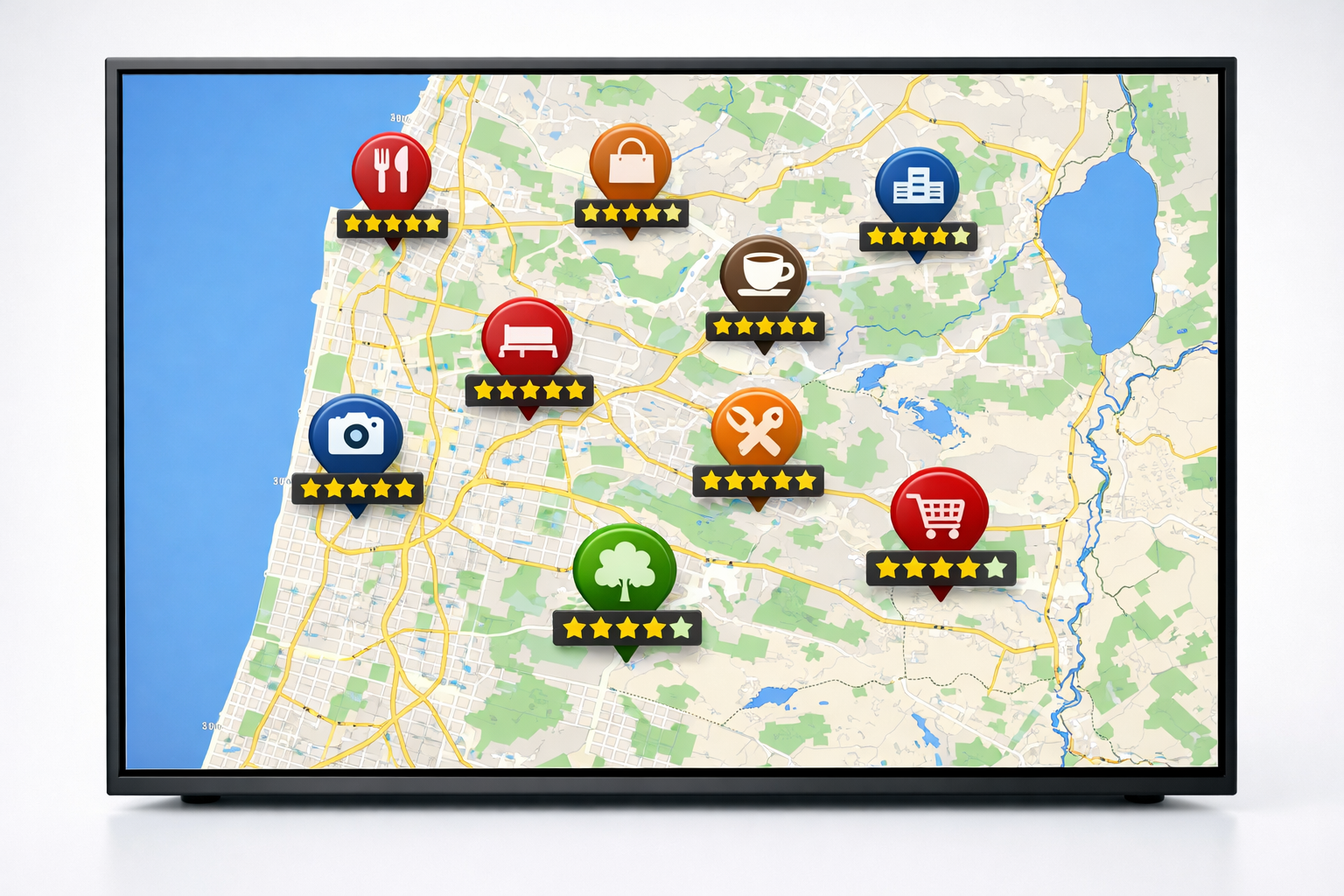
Google reviews are direct ranking signals that determine Map Pack position for location-based queries. This means each positive review functions as a vote for your business’s relevance and trustworthiness in Google’s local algorithm.
Reviews account for 15.4% of local ranking factors according to Whitespark’s annual study. For Israeli businesses competing in local SEO Israel markets, this percentage climbs higher due to lower review volume across the market. When fewer businesses have substantial review counts, each review carries more weight in determining rankings.
Hebrew reviews demonstrate local relevance to Google’s language processing systems. The algorithm recognizes Hebrew content as geographically specific to Israel, creating stronger location signals than English reviews. This geographic specificity explains why Hebrew reviews carry 15% more ranking weight than English for location-specific queries.
Review velocity triggers Google’s attention more than total review count. A business receiving 2-4 reviews monthly shows stronger ranking stability than businesses with 200 old reviews but no recent activity. Google Business Profile optimization requires consistent review generation, not just historical accumulation.
Keywords within review text match user search queries. When customers mention “מוסך בחיפה” (garage in Haifa) in Hebrew reviews, that business gains relevance for Hebrew searches containing those terms. This query matching connects review content to local search visibility.
How to Build a Review Generation System That Works in Israel

Review generation systems automate the request process while maintaining personal connection with customers. This means setting up touchpoints that prompt satisfied customers to leave feedback without creating friction in their experience.
Building an effective system requires these steps:
Create WhatsApp follow-up sequences within 24-48 hours of service completion. Israeli customers respond to WhatsApp at 73% higher rates than email because the platform integrates with their daily communication habits.
Install QR codes at payment counters and exit points linking directly to your Google Business Profile review page. Position codes at eye level with Hebrew instructions: “עזרו לנו לשפר – סרקו וחלקו את החוויה שלכם” (Help us improve – scan and share your experience).
Time requests based on service type – restaurants should request reviews immediately after positive dining experiences, while contractors should wait 1-2 weeks to ensure project satisfaction remains high.
Craft Hebrew prompts for Hebrew-speaking customers and English prompts for English speakers. Hebrew prompts should use formal language structure: “נשמח לשמוע על החוויה שלכם” (We would be happy to hear about your experience).
Balance automated and manual touchpoints – use automated WhatsApp messages for consistency but include personal follow-up calls for high-value customers or negative feedback situations.
Businesses using QR codes see 67% more review attempts than verbal requests because customers can complete the action immediately rather than forgetting later. The key is removing friction between customer satisfaction and review completion.
What Review Velocity Pattern Triggers Google’s Attention?

Review velocity determines algorithmic trust signals that Google uses to validate business legitimacy. This means the timing and frequency of incoming reviews affects how Google perceives your business’s authenticity and customer satisfaction levels.
| Business Size | Monthly Review Target | Trust Signal Impact |
|---|---|---|
| 1-5 employees | 2-4 reviews | High stability, low suspicion |
| 6-20 employees | 4-8 reviews | Optimal for ranking growth |
| 21+ employees | 8-15 reviews | Requires careful pacing |
| New businesses | 1-2 reviews first month | Gradual increase prevents flags |
| Seasonal businesses | 50% reviews in peak season | Natural fluctuation accepted |
Businesses receiving 2-4 reviews monthly show the strongest ranking stability because this velocity appears natural to Google’s spam detection systems. Higher velocities trigger manual review, while lower velocities signal declining customer satisfaction.
Seasonal patterns for Israeli businesses follow holiday and weather cycles. Tourist-dependent businesses see natural review spikes during summer months and Jewish holidays when domestic travel increases. Google’s algorithm accounts for these predictable fluctuations.
Red flags include receiving more than 10 reviews within one week, multiple reviews with identical phrasing, or review clusters from accounts with no review history. These patterns trigger Google’s spam filters and can result in review removal or ranking penalties.
Industry benchmarks vary by business type. Restaurants and retail stores can sustain higher review velocities than professional services because they serve more customers daily. A dental office receiving 15 reviews monthly raises suspicion, while a restaurant receiving 15 reviews weekly appears normal.
Hebrew Review Response Templates That Actually Convert

Review response templates improve customer engagement rates by providing consistent, professional communication that encourages repeat business and referrals. This means having prepared responses that sound personal while addressing common review themes efficiently.
| Response Type | Hebrew Template | English Template |
|---|---|---|
| Positive reviews | “תודה רבה על הביקורת החמה! אנחנו שמחים שהשירות עמד בציפיות שלכם” | “Thank you for the wonderful review! We’re thrilled the service met your expectations” |
| Negative reviews | “אנחנו מצטערים לשמוע על החוויה. נשמח לדבר איתכם ישירות לפתרון” | “We’re sorry to hear about your experience. We’d like to speak with you directly for resolution” |
| Service mentions | “שמחים שהצוות שלנו עזר! נשמח לראותכם שוב בקרוב” | “Happy our team helped! We look forward to seeing you again soon” |
Businesses using Hebrew responses see 28% higher follow-up customer visits because responding in the customer’s native language demonstrates cultural awareness and personal attention. The key is matching the language and formality level of the original review.
Keyword integration without sounding robotic requires natural mention of services or location. Instead of forcing “מוסך בתל אביב” into every response, use variations like “הצוות שלנו בתל אביב” (our team in Tel Aviv) or “השירות שלנו” (our service) that feel conversational.
Cultural considerations for Israeli customers include using appropriate formality levels. Use formal Hebrew (“אתם”) for professional services and casual Hebrew (“אתה/את”) for retail or restaurant businesses. Avoid overly flowery language that sounds insincere.
Response time expectations in Israel are 24 hours or less. Israeli customers expect businesses to monitor and respond to feedback actively. Delayed responses signal poor customer service and reduce the conversion impact of your response templates.
Which Review Monitoring Tools Work for Hebrew Content?

Reputation monitoring tools track multilingual review mentions across platforms to provide comprehensive oversight of your business’s online reputation. This means having systems that can process Hebrew text and alert you to new feedback requiring response.
| Tool Feature | Hebrew Capability | Monthly Cost |
|---|---|---|
| Google Business Profile alerts | Native Hebrew support | Free |
| BirdEye Hebrew processing | 73% accuracy | $299+ |
| ReviewTrackers Hebrew | Limited support | $99+ |
| Manual monitoring setup | 100% accuracy | Free |
| WhatsApp business notifications | Native Hebrew | Free |
Hebrew sentiment analysis accuracy sits at 73% versus 94% for English because Hebrew’s grammatical complexity challenges automated processing systems. Tools struggle with Hebrew slang, colloquialisms, and mixed Hebrew-English text common in Israeli reviews.
Automated alert setup for new reviews requires connecting your Google Business Profile to email or SMS notifications. Configure alerts in your Google Business Profile dashboard under “Notifications” to receive immediate updates when customers leave feedback.
Monitoring competitor review strategies involves tracking their response patterns, review velocity, and keyword usage in responses. Check competitors monthly to identify successful tactics you can adapt for your business.
Tracking review sentiment across platforms requires monitoring beyond Google – include Facebook, Waze, and Israeli business directories relevant to your industry. Each platform’s reviews contribute to overall online reputation even if they don’t directly affect Google rankings.
Integration with Israeli business systems often means connecting review monitoring to existing CRM or customer service platforms. Many Israeli businesses use local CRM systems that require custom integration rather than standard tool connections.
Frequently Asked Questions
How long should I wait between asking customers for reviews?
Wait 2-3 weeks between review requests to the same customer. Shorter intervals feel pushy and longer gaps miss the satisfaction window when service memories are fresh. Multiple requests to the same customer can damage the relationship and trigger spam complaints.
Should I respond to every Google review in Hebrew or English?
Match the language of the original review. Hebrew reviews get Hebrew responses, English reviews get English responses. This shows cultural awareness and improves customer connection rates by demonstrating you understand and respect their communication preferences.
What happens if I get too many reviews too quickly?
Google flags businesses receiving more than 10 reviews per week as potentially suspicious. Sudden review spikes trigger manual review of your business profile and can result in review removal or ranking penalties. Maintain steady, natural review velocity to avoid algorithmic suspicion.