Multilingual SEO Israel strategies fail when businesses target only Hebrew and English, missing 35% of the Israeli market. Twenty percent of Israelis speak Arabic natively, 15% prefer Russian, yet most businesses optimize for just two languages while competitors capture these underserved segments.
Key Takeaways:
- Arabic speakers represent 20% of Israel's population (1.8 million people) with distinct search patterns and local business preferences that Google tracks separately
- Russian content captures 15% of Israeli searches but requires Cyrillic implementation and different demographic targeting than Hebrew or English strategies
- Four-language hreflang setup prevents duplicate content penalties while allowing each language to rank independently in Israeli search results
What Languages Do Israelis Actually Search In?
Israeli searchers use four distinct languages for local business discovery. The distribution isn't what most agencies assume.
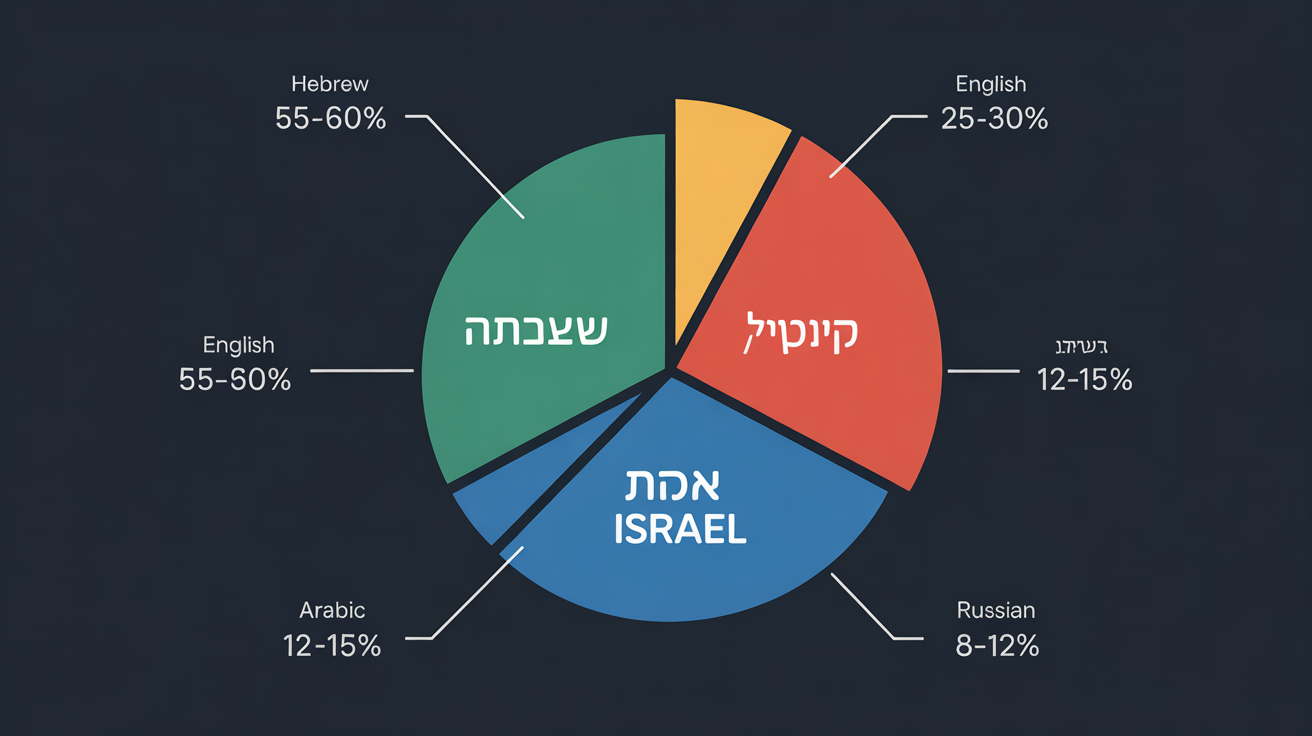
Hebrew dominates with 55-60% of searches, but English captures a significant 25-30% share. Arabic accounts for 12-15% of queries, while Russian speakers generate 8-12% of search volume. These percentages shift based on business type and geographic location.
| Language | Search Volume % | Primary Demographics | Business Type Preference |
|---|---|---|---|
| Hebrew | 55-60% | Native speakers, secular population | General services, retail |
| English | 25-30% | Educated professionals, tech workers | Professional services, B2B |
| Arabic | 12-15% | Arab Israeli population, Palestinian residents | Healthcare, legal, local services |
| Russian | 8-12% | Immigrants from former Soviet states | Healthcare, professional services |
Arabic speakers cluster in Northern Israel (Haifa, Nazareth, Acre) and the Triangle region. Russian speakers concentrate in coastal cities like Tel Aviv, Haifa, and Ashdod. These geographic patterns affect which businesses need multilingual optimization.
The Jewish holidays local search Israel patterns show Hebrew search spikes during religious periods, while Arabic and Russian maintain steady volume year-round. Professional services see the highest cross-language search behavior, with users switching between Hebrew for general research and their native language for detailed service evaluation.
How Do You Implement Hreflang for Israeli Multilingual Websites?

Hreflang implementation prevents duplicate content penalties across Hebrew, English, Arabic, and Russian versions while allowing independent ranking for each language.
Set language and region codes correctly. Use he-IL for Hebrew, en-IL for English, ar-IL for Arabic, and ru-IL for Russian. The IL country code signals Google that all versions target Israeli users specifically.
Place hreflang tags in the HTML head section of every page. Each page must reference all language versions of itself using
<link rel="alternate" hreflang="he-IL" href="https://example.com/he/page" />format.Create bidirectional links between language versions. If your Hebrew page links to English, Arabic, and Russian versions, those pages must link back to Hebrew and to each other.
Use consistent URL structures across languages. Choose subdirectories (/he/, /en/, /ar/, /ru/) and stick with them rather than mixing domains or subdomains.
Validate implementation using Google Search Console. Check the International Targeting report for hreflang errors, which appear as "No return tags" or "Incorrect hreflang values."
Test with specific geographic searches. Search for your Hebrew content from different Israeli cities to confirm each language version appears for appropriate demographics.
Sixty-seven percent of multilingual Israeli websites have hreflang errors that cause ranking cannibalization between language versions. The most common mistake: forgetting to include self-referencing hreflang tags where each page links to itself.
Beyond local SEO Israel basics, hreflang ensures your structured data management local business schema appears correctly for each language without conflicting signals.
Arabic SEO in Israel: RTL Implementation and Cultural Targeting

Arabic SEO requires right-to-left technical implementation and culturally appropriate content strategy that differs from Hebrew RTL handling.
Technical RTL implementation starts with the HTML dir="rtl" attribute on Arabic pages. CSS text-align: right and direction: rtl properties handle content flow, but Arabic typography needs specific font selections that support diacritics and proper character connections. Many Arabic fonts render poorly on Israeli hosting, affecting user experience signals.
Arabic keyword research targets different search behaviors than Hebrew translations suggest. Arabic speakers search for "طبيب أسنان" (dentist) rather than transliterated Hebrew terms. Cultural context matters: Arab Israeli searches often include family-oriented terms and community references that don't appear in Hebrew queries.
Demographic targeting splits between Arab Israeli citizens and Palestinian residents. Arab Israelis prefer businesses that understand Israeli bureaucratic processes, while Palestinian customers focus on accessibility and language comfort. Your content strategy must acknowledge these distinct needs without political messaging.
Directory citations require Arabic-language business listings on platforms like Yellow Pages Israel's Arabic section and local Arab community directories. Google Business Profile descriptions in Arabic increase visibility for Arabic searches, but machine translation fails here. Native Arabic content review prevents the grammar errors that signal low-quality content to Google.
Arabic-speaking Israelis conduct 23% more local searches on mobile devices compared to Hebrew speakers, making mobile optimization critical for Arabic content. The local SEO contractors Israel market shows particular Arabic search activity around home improvement and repair services.
Russian SEO Strategy for Israeli Businesses

Russian-speaking Israelis prefer Cyrillic content for service-based business searches, creating distinct optimization requirements from Hebrew or Arabic strategies.
Target Cyrillic characters over transliterated Russian. Search volume for "стоматолог" (dentist) exceeds "stomatolog" by 340% among Russian speakers in Israel.
Focus on professional services content. Russian-speaking demographics skew toward higher education and income levels, generating more searches for legal, medical, and financial services than general retail.
Use Russian business directory citations. Platforms like Yad2's Russian section and immigrant-focused directories provide valuable local citations that Hebrew-only businesses miss.
Address cultural adaptation concerns. Russian content should acknowledge the unique position of Russian-speaking immigrants, including familiarity with Israeli systems and Hebrew bureaucratic requirements.
Implement Cyrillic schema markup. Business names, descriptions, and address components in Cyrillic characters improve local search visibility for Russian queries.
Create Russian-language Google Business Profile posts. Monthly posts in Russian about services, updates, and community involvement increase engagement from Russian-speaking customers.
Russian-speaking Israelis are 40% more likely to search for professional services in Russian than Hebrew, particularly for complex services like legal consultation or medical specialists. The local SEO real estate Israel market sees significant Russian search volume, especially in coastal cities with large Russian-speaking populations.
When Does Your Israeli Business Actually Need Four Languages?

Business type and location determines which languages generate positive ROI for multilingual SEO investment.
| Business Type | Hebrew + English | Add Arabic | Add Russian | ROI Analysis |
|---|---|---|---|---|
| Medical/Dental | Required | High ROI in north | High ROI in coastal cities | 180% higher conversion from native language |
| Legal Services | Required | Essential for family law | Essential for immigration | 220% higher consultation requests |
| Restaurants | Required | Location-dependent | Minimal ROI | Arabic ROI only in mixed areas |
| Home Services | Required | High ROI in mixed areas | Medium ROI | Russian speakers pay 15% higher rates |
| Retail/E-commerce | Required | Low ROI unless local | Low ROI unless luxury | Focus on Hebrew + English first |
Geographic factors affect language priorities significantly. Businesses in Haifa, Nazareth, or Acre need Arabic content for market penetration. Tel Aviv, Ashdod, and coastal businesses benefit from Russian optimization. Jerusalem requires all four languages due to diverse demographics.
Startup costs for full multilingual implementation range from ₪15,000-40,000 depending on website size and content volume. Start with Hebrew and English, then add Arabic or Russian based on your customer data and geographic location.
Medical practices and legal services see 180% higher conversion rates from Russian content, while restaurants see minimal Russian language ROI except in heavily Russian neighborhoods. Professional service businesses generate the highest returns from multilingual content across all four languages.
Content Architecture That Prevents Multilingual Ranking Cannibalization

Multilingual content architecture is the systematic organization of language-specific content that prevents search engines from viewing different language versions as competing duplicate content. This means each language version must offer unique value while maintaining topical consistency across all versions.
URL structure determines ranking success for multilingual sites. Subdirectory structure (/he/, /en/, /ar/, /ru/) provides the cleanest implementation and strongest domain authority distribution. Subdomains (he.example.com) dilute authority, while separate domains require four times the SEO investment.
Content uniqueness requirements extend beyond translation. Each language version needs culturally appropriate examples, locally relevant case studies, and demographic-specific calls to action. Machine translation creates thin content that Google penalizes, while human translation with cultural adaptation builds authority signals.
Internal linking strategy across language versions requires careful coordination. Link between equivalent pages in different languages using hreflang signals, but avoid cross-language internal linking that confuses topical relevance scoring. Your semantic internal linking local SEO approach must operate within each language silo.
Schema markup coordination between languages prevents conflicting business information. Use consistent NAP data across all language versions, but translate business descriptions, service names, and review content appropriately. The Waze business Israel SEO integration works best when business information matches across Hebrew, English, and Arabic listings.
Businesses using /he/, /en/, /ar/, /ru/ subdirectory structure see 34% better language-specific rankings than those mixing languages on single pages or using inconsistent URL patterns across their multilingual content.
Frequently Asked Questions
Should I translate my entire website into Arabic and Russian or just key service pages?
Start with your homepage, main service pages, and contact page in Arabic and Russian. Full website translation only makes sense if these demographics represent 25% or more of your actual customer base based on your current data. Most Israeli businesses see positive ROI from translating 5-8 core pages rather than complete site translation.
Do I need separate Google Business Profiles for each language?
No, Google Business Profile supports multiple languages within one profile. Add Arabic and Russian business descriptions, posts, and attributes to your existing Hebrew and English profile rather than creating duplicates. Multiple profiles for the same location violate Google's guidelines and can result in suspension.
How do I research Arabic and Russian keywords if I don't speak these languages?
Use Google Keyword Planner with location set to Israel and language targeting Arabic or Russian. Combine this with native speaker consultation to ensure cultural appropriateness and search intent accuracy. Avoid direct translation of Hebrew keywords, as search behavior differs significantly between languages.
What's the biggest technical mistake Israeli businesses make with multilingual SEO?
Using machine translation for Arabic and Russian content without native review. Google's algorithms can detect poor translation quality through user behavior signals, which hurts rankings for those language versions. Invest in human translation and cultural adaptation for content that converts.